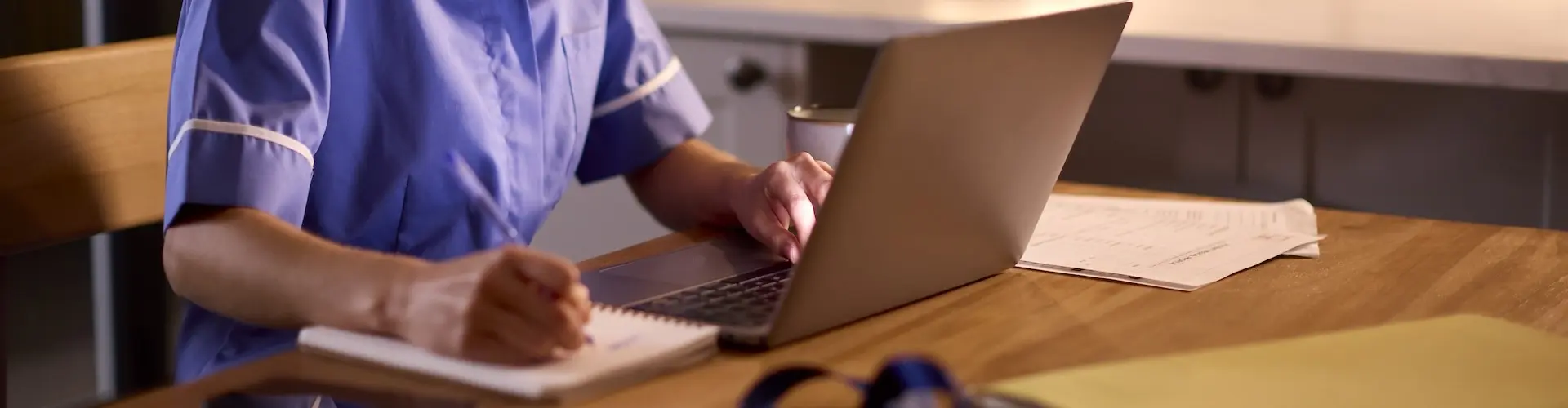
10 Feb 2026 ● Clare Piggot, Occupational Health Nurse Advisor
From Project 2000 to Occupational Health Nursing
As far back as I can remember I had always wanted to become a Nurse and a Midwife, and I tried to enter nursing as soon as I was 17 years old. At that time in Northern Ireland there were two intakes every year to each of the training hospitals across the North. I however, continued my school education into A levels and was on several waiting list to start nurse training. I kept applying to nursing but continued in education, undertaking a graphic design and photography course whilst waiting.
I managed to secure a place at the Eastern Area College of Nursing Southside (Belfast City Hospital) in October 1992. By this time, the introduction of Project 2000 (P2K) had just started in April of that year. However, despite this, our general nurse training followed a very traditional path, as many of you may remember from your own training days.
After qualifying as an Adult Nurse, I moved to the Isle of Man to commence my career on a general medical ward. This gave me the strong base to later move and progress into a speciality in England which was cardiothoracic nursing and high dependency care, and later into midwifery. I undertook my midwifery training and BSc (Hons) degree via St George’s Medical School in London and Kingston University, qualifying in 1999.
Throughout my career I have worked in a variety of clinical settings and specialities, both as a Registered Nurse and a Registered Midwife either within the NHS or private healthcare sector, but one common theme I saw was the lack of early occupational health utilisation.
The inspiration that was the catalyst for my change.
One event saw me meet with an Occupational Health Physician (OHP) after spinal surgery who was, in my perspective, disinterested, disengaged, unempathetic and dismissive. I was offered no support, no suggestion of adjustments, and quite frankly told to consider a different career as "nurses and midwives cannot work with a bad back". My return-to-work manual handling assessment was to teach me how to move an empty patient bed. Nothing more, nothing less!
This experience stayed with me so acutely that when I progressed in my dual career to where I was the manager now referring staff, I was diligent in ensuring early occupational health input and seeking their advice on robust supportive accommodations to keep my staff in work, returning to work, or well supported in time of ill health.
But how does one enter occupational health nursing, when you need occupational health experience?
My desire to, as I call it, "do a better job of it" led me in 2021 to move from the NHS. I knew that to gain excel in occupational health I would need access. Never one to be defeated, I recognised the gaps in my practice and knowledge. So, I moved to working in global case management, health and disability assessment, employee assistance and on into occupational health itself.
In April 2023 I was delighted to secure a training role with a large occupational health provider Optima Health, and spent six months on their internal training GROW programme which gave me an excellent foundation of occupational health knowledge. I now mentor new trainees and offer mentoring support to new staff. Furthermore, I am currently undertaking the BSc Occupational Health degree through Robert Gordon University with my employer’s support and funding. I currently work across several industries, sectors and global organisations providing pre-employment assessment, health surveillance, performance and attendance management and dedicated case management.
What does a nurse midwife bring to occupational health?
Within this role I am able to use my wide clinical knowledge and experience to evaluate, assess, health screen, listen, offer support, provide impartial researched backed advice and well written reports, and signpost or refer employees on to specialist services such as physiotherapy, mental health therapies and workplace coaching, ensuring there is a wholistic plan of support in place for them to successfully commence or remain in work, or return to work and sustain long term attendance and strong performance. I also do regular expectant mother or return to work after maternity leave assessments.
Solid evidence based and up to date health promotion and wellbeing is an integral part of my career thus far, and indeed vital in my current occupational health role as well. I strongly believe in “every contact counts”, and the UK government 2024 key slogan of "good work is good for health" resonates strongly with me. Therefore, employee and management engagement with occupational health alongside promotion of health and wellness is, in my opinion, a fundamental aspect of my role. I would like to believe that I help to make that difference when it is needed most, and this is where the joy in my work lies.
Whilst I am aware that I am still fairly early in my occupational health career I am excited for its future progression. It goes to show you that you can indeed teach old nurses new tricks!!
Reference list
- Kendell, L. (2024). ‘Good work is good for health’ Work & Pensions and Health Secretaries declare on visit to health and work support service. (GOV.UK)
- NHS England. (2016). Making Every Contact Count (MECC): Consensus statement. (NHS England)

About the author
Clare Piggot RN RM DipHE Adult Nursing, BSc(Hons) Midwifery: Occupational Health Nurse Advisor for Optima Health – “Together we can make a difference”.