18 Jun 2021 ● Naomi Somers, Student Adult Nurse
A Guide To The Support Available For Student Nurses With A Disability
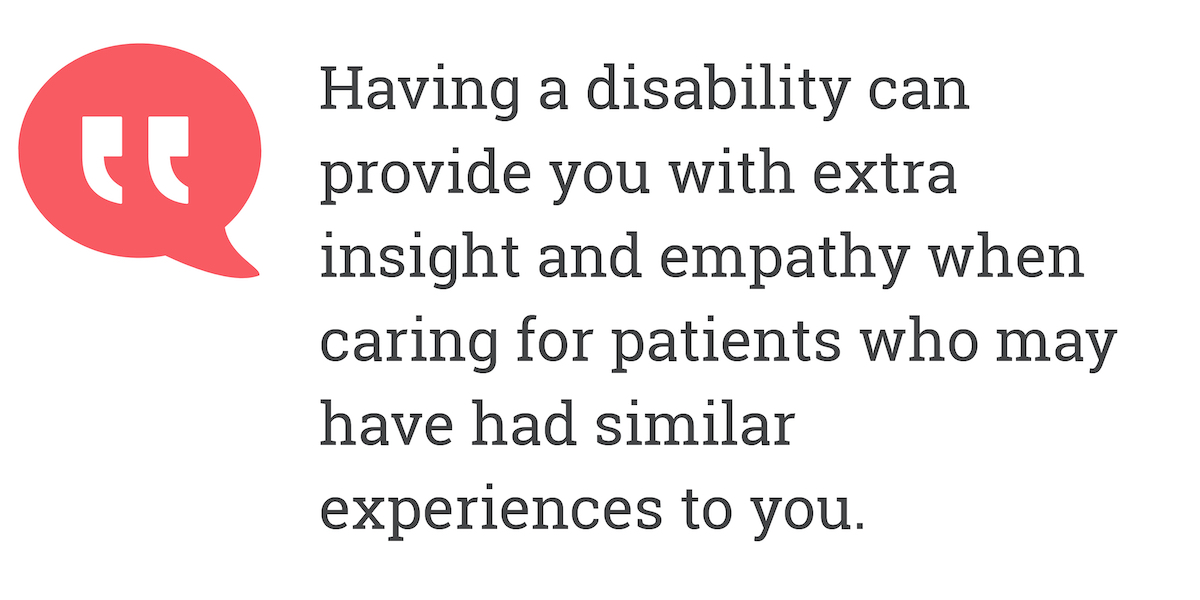
 "Having a disability can provide you with extra insight and empathy when caring for patients who may have had similar experiences to you." - Naomi Somers, Student Nurse
Naomi calls on her own experience to explain how a mental health problem, long term illness or any other disability does not mean you cannot study to be a nurse.
Topics Covered In This Article
Having A Mental Or Physical Disability Does Not Mean You Can’t Become A Nurse
What Role Does Occupational Health Play?
My Experience Obtaining Occupational Health Clearance
What Are Reasonable Adjustments?
Reasonable Adjustments That Were Made For Me
What Is A Disabled Students’ Allowance?
How Do You Apply for Disabled Students’ Allowance?
The Support I Received From DSA
Having A Mental Or Physical Disability Does Not Mean You Can’t Become A Nurse
Whilst you need to be able to be fit enough to complete the course, having a mental or physical disability does not automatically exclude you from becoming a nurse.
Although I don’t have a physical disability, I do suffer from mental illness.
And ‘If you can’t even look after yourself, how do you expect to care for somebody else?’ is a phrase I’ve heard too often from people referring to student nurses with physical or mental illness.
When applying to university, I was worried I might not be accepted because of my mental health but looking back, I know that universities support their students as best as they can and they need accurate information about their health in order to do this.
Having a disability can provide you with extra insight and empathy when caring for patients who may have had similar experiences to you and it’s important to understand that you won’t be rejected from the course lightly.
The Nursing and Midwifery Council (NMC) state:
“Good health is necessary to practise as a nurse. Good health means that you must be capable of safe and effective practice without supervision. It does not mean the absence of any disability or health condition. Many people with disabilities and health conditions are able to practise with or without adjustments to support them.”
What Role Does Occupational Health Play?
Before you begin studying Nursing, you are required to obtain a satisfactory occupational health clearance by your university, due to the nature of the course.
This is because your university has a duty of care to ensure that you are fit for all aspects of the course, including placement, and that others are safe in your care.
It’s important that you answer any questions honestly and disclose any relevant mental or physical health issues that may affect your fitness to practice.
You will usually be sent an occupational health questionnaire to complete shortly after your place on your course is confirmed and depending on your answers, you may be contacted for a follow-up assessment.
Occupational health clearance is mandatory and if you fail to communicate with occupational health, your place on your course may be withdrawn.
However, it’s important to remember that occupational health services are there to support you, not hinder you, and they can help you with any health-related concerns whilst at work.
For example, if you are suffering from dermatitis that is exacerbated by frequently washing your hands whilst on placement, occupational health may be able to provide you with advice or offer you a special hand wash or moisturising cream to use to minimise irritation.
My Experience Obtaining Occupational Health Clearance
In my occupational health questionnaire, I disclosed that I have depression and social anxiety disorder.
Not long after I submitted my questionnaire, I received a phone call from the occupational health nurse to discuss my mental health issues in more detail, including how they affect my everyday life and when I was first diagnosed.
I explained that I have received counselling in the past although I now take regular medication to try and control my symptoms.
Although my depression and anxiety can cause me many problems, the nurse reassured me that I would be cleared for practice.
She also asked for my permission to pass on my information to the university’s student wellbeing team and explained that they may be able to put in place reasonable adjustments for me.
What Are Reasonable Adjustments?
Reasonable adjustments are changes that can be made for students with a disability or health condition in order to reduce any barriers they may experience whilst at university or on placement and ensure they are not disadvantaged compared to other students.
Examples of reasonable adjustments include allowing placement shifts to be planned around medical appointments, permission to use a computer during examinations and access to ergonomic equipment.
Reasonable Adjustments That Were Made For Me
After the occupational health nurse passed my information on to my university’s student wellbeing team, someone from their team contacted me to arrange an appointment at the university’s campus to look at what kind of support might be available to put in place for me before my course commenced.
At this appointment, I was able to explain how I often have difficulty concentrating and because of this, it can take me longer to read and write and complete certain tasks.
I also talked about how I lack energy a lot of the time and find it hard to get motivated.
An individual support plan was then created for me and I was told that I would be offered the following concessions because of how my mental health has an effect on my ability to study:
● allowed 25% extra time in examinations
● a one week extension on assessments
● able to loan library books for longer when being allocated for placements
● a note was made on my profile to consider placing me closer to home where possible
● I was also encouraged to apply for Disabled Students’ Allowance
What Is A Disabled Students’ Allowance?
Disabled Students’ Allowance (DSA) is a grant available from Student Finance to students with a mental health problem, long term illness or any other disability in order to help cover any additional study-related costs required due to their condition(s).
This may be in the form of providing specialist equipment, funding for a non-medical helper or reimbursement for extra travel costs encountered due to disability.
DSA does not cover any costs that you would have if you were not a student or any costs that a student without a disability would have.
How Do You Apply for Disabled Students’ Allowance?
In order to apply for DSA (Disabled Students’ Allowance), you need to fill out the DSA application form available on the Student Finance website which you can either return by email or print off and return by post.
As part of your application, you will need to give the name or diagnosis and provide photocopy evidence of your disability.
The exact type of evidence you will need to supply will depend on your disability but you can expect to need to provide a written statement from a doctor or other qualified medical professional.
Once your application has been received, if you are eligible for DSA, you may need to attend a Study Needs Assessment.
During this assessment, the assessor will determine what sort of equipment or other support you may need during your course.
The assessor will then write this up in a report which is sent back to Student Finance who then review these recommendations and make the final decision on what specific equipment or support they will fund.
The Support I Received From DSA
Initially, I was surprised that I was encouraged to apply for DSA as I never thought of myself as having a disability but I was assured that with my mental health conditions I should be eligible for support.
I supplied a photocopy of a written statement from my GP in my application and soon after sending it off, I received an email to let me know that I was eligible for DSA and that I needed to arrange a Study Needs Assessment.
Software And Funding For New Computer
I attended this assessment at my university’s campus and after talking about how my mental health conditions affect my everyday life and ability to study, I was shown some computer software that would help me whilst studying.
The assessor also thought that I would benefit from talking to a specialist mentor each week and I agreed that I would find this really helpful.
After my assessment, I was emailed a copy of the report that was sent to Student Finance England including the recommendations for funding.
Shortly after, I received an email from Student Finance to let me know that they had approved funding for everything recommended in the report.
Because the laptop I owned wasn’t compatible with the software I needed, I paid the first £200 towards the cost of a new laptop which would support this software and the rest of the cost was funded for.
I now use this software all the time and it’s really helped me when writing assignments and revising and I don’t know how I used to manage without it.
Funding For Specialist Mentor
I also received funding to allow me to meet with a specialist mentor from the university for an hour each week, which has been extremely helpful.
When I’m struggling to keep up with the demands of university, placement and my personal life it’s really nice to have someone to talk to about it all and offload.
We can talk about anything, not just university, and it’s great to have some support and advice when I’m finding things difficult.
Conclusion
Overall, I’m so glad I applied for DSA and my university has been really helpful in supporting me along my degree.
Having a mental health problem, long term illness or any other disability does not mean you cannot study to be a nurse and I would encourage everyone to make the most out of the support available to them whilst at university. Click here to find learning disability nursing jobs and to learn about the average salary in the UK.